
Recent Policosanol Research Confirms
Benefits of Policosanol!
 Recent Policosanol Research 1
Dr. Teresa C. Hill, for the Journal-Advocate
Recent Policosanol Research 1
Dr. Teresa C. Hill, for the Journal-Advocate
POSTED: 01/28/2013
Policosanol was tested against statins and lowered LDL cholesterol as much as levostatin and pravastatin. In this same clinical trial Lipitor and policosanol both significantly lowered cholesterol, but the policosanol significantly raised the HDL (good cholesterol).
The group studied in the recent policosanol research did not raise the liver enzymes like the Lipitor group did. Policosanol also helped to lower glucose, CPK and liver AST enzymes.
Pub Med - Recent Policosanol Research
Med Hypotheses. 2026;64(3):636-45. An ezetimibe-policosanol combination has the potential to be an OTC agent that could dramatically lower LDL cholesterol without side effects. McCarty MF. NutriGuard Research, 1051 Hermes Avenue, Encinitas, CA 92024, USA.
Although many risk factors influence atherogenesis, LDL appears to play a primary role in this process. In prospective epidemiology, coronary risk increases as LDL cholesterol increases, throughout the entire range of concentrations encountered in healthy humans.
Coronary risk is minimal in individuals and populations whose serum cholesterol remains quite low throughout life. Thus, practical strategies for achieving large reductions of LDL cholesterol in the general population could have a dramatic impact on coronary mortality rates.
Pub Med - Recent Policosanol Research
Concomitant use of policosanol and beta-blockers in older patients. Castano G, Mas R, Gamez R, Fernandez J, Illnait J, Fernandez L, Mendoza S, Mesa M, Gutierrez JA, Lopez E. Center for Natural Products, National Center for Scientific Research, Havana City, Cuba.
Policosanol is a cholesterol-lowering drug with concomitant antiplatelet effects. It is safe and well tolerated, even in populations with high consumption of concomitant drugs.
These data suggest that adverse events (AE) due to drug-to-drug interactions (DDI) with policosanol are not relevant. Experimental data indicate that potential DDI between policosanol and drugs metabolized through the cytochrome P450 hepatic system are not expected, but pharmacodynamic DDI cannot be excluded.
Several recent policosanol research studies have shown that policosanol decreased arterial pressure compared with placebo, and a pharmacological interaction with beta-blockers was experimentally proven. Therefore, clinical DDI between policosanol and beta-blockers can be expected.
This study investigated whether policosanol reinforces the antihypertensive effects of beta-blockers and/or whether this combination impairs some safety indicators or induces specific AE in older patients.
After 5 weeks on a diet-only baseline period, 205 older hypercholesterolemic patients taking beta-blockers were randomized to policosanol 5 mg/day or placebo for 3 years.
After 1 year on therapy, policosanol significantly reduced low-density lipoprotein-cholesterol (LDL-C) (20.9%), total cholesterol (TC) (19.3%) and triglycerides (TG) (25.7%), whereas it increased (p 0.01 and p 0.001 versus placebo) high-density lipoprotein-cholesterol (HDL-C) levels (4.1%).
Treatment effects did not to wear off during the 3-year follow-up. At study completion, policosanol lowered (0.00001 versus placebo) LDL-C (34.3%), TC (23.2%) and TG (21.2%) and raised (p 0.00001 versus placebo) HDL-C (12.3%).
Thirty-one patients (15.1%) discontinued the study, 22 in the placebo group (20.6%) and nine in the policosanol group (9.2%). Of these, 20 patients (16 in the placebo group and four in the policosanol group) withdrew from the study due to AE. The frequency of serious adverse events (SAE), mostly vascular, in policosanol patients (3/98, 3.1%) was lower than in the placebo group (15/107, 14.0%).
Blood pressure improved with policosanol according to recent policosanol studies
Reductions in systolic and diastolic blood pressure were observed in policosanol patients compared with those in the placebo group.
Summary of Benefits According to Recent Policosanol Research
In conclusion, policosanol was well tolerated in elderly patients taking beta-blockers and did not increase AE. Additional reduction of blood pressure and a lower frequency of SAE were observed in policosanol patients compared with those taking placebo.
Meta-analysis of natural therapies for hyperlipidemia: plant sterols and stanols versus policosanol.
School of Pharmacy and Pharmacal Sciences, Purdue University, West Lafayette, Indiana To compare the efficacy and safety of plant sterols and stanols as well as policosanol in the treatment of coronary heart disease, as measured by a reduction in low-density lipoprotein cholesterol (LDL) levels.Pharmacotherapy. 2026 Feb;25(2):171-83. Chen JT, Wesley R, Shamburek RD, Pucino F, Csako G.
Need a less technical, condensed, easier to understand "Readers Digest" version of the Recent Policosanol Research?
Click on this Policosanol linkThe net LDL reduction in the treatment groups minus that in the placebo groups was greater with policosanol than plant sterols and stanols (-24% versus -10%). Policosanol also affected total cholesterol, high-density lipoprotein cholesterol (HDL), and triglyceride levels more favorably than plant sterols and stanols.
Policosanol caused a clinically significant decrease in the LDL:HDL ratio. CONCLUSION: Plant sterols and stanols and policosanol are well tolerated and safe; however, policosanol is more effective than plant sterols and stanols for LDL level reduction and more favorably alters the lipid profile, approaching antilipemic drug efficacy.
After one year, policosanol reduced significantly low-density lipoprotein-cholesterol (LDL-C) (21 %), total cholesterol (TC) (17 %) and triglycerides (TG) (16 %), whereas increased high-density lipoprotein-cholesterol (HDL-C) levels (10 %). No significant changes on lipid profile variables of placebo group occurred during the study. Of 239 randomized patients, 63 (26 %) discontinued the study, 43/120 placebo (35 %) and 20/119 policosanol patients (16 %). Of them, 35 patients (28 placebo, 7 policosanol) withdrew from the study due to some adverse effect.
The frequency of serious adverse events, most vascular, in policosanol patients was lower than in respective placebo. Five patients, all placebo, died during the study, four of them due to myocardial infarction. No drug-related impairment of safety indicators, particularly on glycemic control, was observed. Nevertheless, a reduction of systolic and diastolic blood pressure was observed in policosanol patients compared with placebo. The overall frequency of policosanol patients reporting mild and/or moderate was similar than in placebo. It is concluded that policosanol was long-term effective, safe and well tolerated on patients with dyslipidemia due to Type 2 diabetes.
Effects of policosanol and ticlopidine in patients with intermittent claudication: a double-blinded pilot comparative study. Angiology. 2026 Jul-Aug;55(4):361-71.
Policosanol is a cholesterol-lowering drug with concomitant antiplatelet effects. The present study was undertaken to compare the effects of policosanol and ticlopidine in patients with moderately severe intermittent claudication (IC). The study had a 4-week baseline step, followed by a 20-week double-blinded, randomized treatment period. Twenty-eight eligible patients were randomized to policosanol 10 mg or ticlopidine 250 mg tablets twice daily (bid)
.Walking distances in a treadmill (constant speed 3.2 km/hr, slope 10 degrees, temperature 25 degrees C) were assessed before and after 20 weeks of treatment. Both groups were similar at baseline. Compared with baseline, policosanol significantly increased (p mean values of initial (ICD) and absolute (ACD) claudication distances from 162.1 to 273.2 m and from 255.8 to 401.0 m, respectively. Ticlopidine also raised significantly ICD (166.2 to 266.3 m) and ACD (252.9 to 386.4 m). Comparisons between groups did not show significant differences.
Policosanol, but not ticlopidine, significantly, but modestly, increased the ankle/arm pressure ratio. After 10 weeks, policosanol significantly lowered low-density lipoprotein-cholesterol (LDL-C), total cholesterol (TC) (p , and TC/HDL-C and raised (p high-density lipoprotein-cholesterol (HDL-C). At study completion, policosanol lowered LDL-C (30.2%), TC (16.9%), and TC/HDL-C (33.9%), increased HDL-C (+31.7%), and left triglycerides unchanged. Ticlopidine did not affect the lipid profile variable. Policosanol induced modest, but significant, reductions of fibrinogen levels compared with baseline and ticlopidine. Treatments were well tolerated and did not impair safety indicators.
Three ticlopidine patients (21.4%) withdrew from the trial, only 1 owing to a serious adverse experience (AE) (unstable angina). Three other ticlopidine patients experienced mild AE (headache, diarrhea, and acidity). It is concluded that policosanol (10 mg bid) can be as effective as ticlopidine (250 mg bid) for improving walking distances of claudicant patients, and it could be advantageous for the global risk of these individuals owing to its cholesterol-lowering effects. This study is, however, just a pilot comparison, so that further studies in larger sample sizes are needed for definitive conclusions of the comparative effects of both drugs on patients with IC.
More Recent Policosanol Research. Journal of the American Medical Association, May 17, 2026.
German investigators report that policosanol may not be effective to lower LDL cholesterol. Policosanol is an extract of the waxy coating of sugar cane and other plants, and multiple trials have demonstrated that it safely lowers lipid levels. However, Dr. Heiner K. Berthold says that almost all of these studies came from one group in Cuba, whose research was funded by Dalmer Laboratories, which markets policosanol.
In an attempt to confirm their findings, Berthold, from the Drug Commission of the German Medical Association in Berlin, and his team performed a "rigorously controlled" multicenter study comparing Cuban sugar cane-derived policosanol with an inactive "placebo" supplement.
Their study involved 143 adults with LDL cholesterol levels of at least 150 milligrams per deciliter. Participants were randomly assigned to policosanol at doses of 10, 20, 40 or 80 milligrams daily or placebo. After 12 weeks, the researchers saw no statistically or clinically significant effect on LDL cholesterol at any dose.
Similarly, the investigators report, there were no significant differences among the groups in HDL ("good") cholesterol levels, total cholesterol, very low density-cholesterol, triglycerides, or lipoprotein(a). The study was sponsored by Madaus AG, an international company specializing in plant-derived drugs, which does not manufacture or distribute any cholesterol-lowering drugs.
Note: This small study of only 143 persons conflicts with more than 50 previous studies of 4596 patients during the past 20 years. In fact policosanol is the most widely studied natural supplement in the world. Although many of these studies were first conducted in Cuba there have many others in various countries including the U.S. that have shown the benefits of policosanol.
The study authors say "In none of the 5 treatment groups did LDL-C levels decrease more than 10 percent from baseline."
Although this may surprise some, the fact that this study was published by the Journal of the American Medical Association does not add creditability in my view. The makers of statin drugs advertise heavily on medical mainstream websites and statin drugs are routinely prescribed by 99% of all physicians. Could it be that policosanol is becoming a threat to the giant drug companies? It will take more than this small study to change my mind.
Gene Millen
Recent Policosanol Research of Concomitant use of policosanol and beta-blockers in older patients. Int J Clin Pharmacol Res. 2026;24(2-3):65-77.
Policosanol is a cholesterol-lowering drug with concomitant antiplatelet effects. It is safe and well tolerated, even in populations with high consumption of concomitant drugs. These data suggest that adverse events (AE) due to drug-to-drug interactions (DDI) with policosanol are not relevant. Experimental data indicate that potential DDI between policosanol and drugs metabolized through the cytochrome P450 hepatic system are not expected, but pharmacodynamic DDI cannot be excluded.
Several clinical studies have shown that policosanol decreased arterial pressure compared with placebo, and a pharmacological interaction with beta-blockers was experimentally proven. Therefore, clinical DDI between policosanol and beta-blockers can be expected. This study investigated whether policosanol reinforces the antihypertensive effects of beta-blockers and/or whether this combination impairs some safety indicators or induces specific AE in older patients.
After 5 weeks on a diet-only baseline period, 205 older hypercholesterolemic patients taking beta-blockers were randomized to policosanol 5 mg/day or placebo for 3 years. After 1 year on therapy, policosanol significantly reduced (0.00001 versus placebo) low-density lipoprotein-cholesterol (LDL-C) (20.9%), total cholesterol (TC) (19.3%) and triglycerides (TG) (25.7%), whereas it increased (p 0.01 and p 0.001 versus placebo) high-density lipoprotein-cholesterol (HDL-C) levels (4.1%).
Treatment effects did not to wear off during the 3-year follow-up. At study completion, policosanol lowered (p 0.00001 versus placebo) LDL-C (34.3%), TC (23.2%) and TG (21.2%) and raised (p 0.00001 versus placebo) HDL-C (12.3%). Thirty-one patients (15.1%) discontinued the study, 22 in the placebo group (20.6%) and nine in the policosanol group (9.2%). Of these, 20 patients (16 in the placebo group and four in the policosanol group) withdrew from the study due to AE. The frequency of serious adverse events (SAE), mostly vascular, in policosanol patients (3/98, 3.1%) was lower than in the placebo group (15/107, 14.0%).
No impairment of safety indicators was observed. Nevertheless, reductions in systolic and diastolic blood pressure were observed in policosanol patients compared with those in the placebo group. The frequency of policosanol patients reporting mild or moderate AE (18/98, 18.4%) was also lower than in the placebo group (30/107, 28.0%). In conclusion, policosanol was well tolerated in elderly patients taking beta-block- ers and did not increase AE.
Additional reduction of blood pressure and a lower frequency of SAE were observed in policosanol patients compared with those taking placebo. The cholesterol-lowering efficacy of policosanol was that expected. These results provide support that policosanol therapy added to hypercholesterolemic elderly individuals taking beta-blockers could provide additional benefits in lowering blood pressure; SAE were not more frequent in the policosanol group than in the placebo group and there was no increase in AE.
Recent Policosanol Study by Pub Med Nutr Rev. 2026 Nov;61(11):376-83.
Role of policosanols in the prevention and treatment of cardiovascular disease. Varady KA, Wang Y, Jones PJ. School of Dietetics and Human Nutrition, McGill University, Ste-Anne-de-Bellevue, Quebec, CanadaPolicosanols are a mixture of aliphatic alcohols derived from purified sugar cane. When administered at 5 to 20 mg/day, policosanols have been shown to decrease the risk of atheroma formation by reducing platelet aggregation, endothelial damage, and foam cell formation in animals.
Additionally, policosanols have been shown to lower total and low-density lipoprotein (LDL) cholesterol levels by 13 to 23% and 19 to 31%, respectively, while increasing high-density lipoprotein (HDL) cholesterol from 8 to 29%. Policosanols are thought to improve lipid profiles by reducing hepatic cholesterol biosynthesis while enhancing LDL clearance.
Recent Policosanl Study Confirms Dramatically Fewer Side Effects Compared to Statin Drugs.
When compared with statins, policosanols exhibit comparable cholesterol-lowering effects at much smaller doses. The mixture is well tolerated when administered to animals; however, a more precise safety profile is needed for humans. In summary, policosanols are a promising resource in the prevention and therapy of cardiovascular disease (CVD), but these results need to be confirmed in independent laboratories.
These results provide support that policosanol therapy added to hypercholesterolemic elderly individuals taking beta-blockers could provide additional benefits in lowering blood pressure; SAE were not more frequent in the recent policosanol research group than in the placebo group and there was no increase in AE.
These recent policosanol clinical studies are little difficult to understand if you are not familiar with medical terminology...but the bottom line is that policosanol has an excellent safety record, side effects are rare and minor and it lowers cholesterol as good or better than Lipitor, Crestor or Zocor.
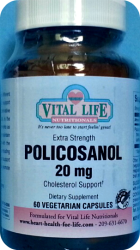 Click here to try Vital Life Nutrionals Policosanol Extra Strength capsules (made with the same formula used in the clinical studies) Save up to 40%.
Thanks for joining us on the journey to Vital Heart Health for Life!

Clinical Studies Research Conducted in 2026 Reported by Dr. Hill1